Save the earth one litter pick at a time.

Eco Communities ask you to act as part of ‘A Billion Acts of Green’ this Earth Day and become a volunteer

Today April 22nd it’s Earth Day, Earth Day started in 1970 and now has more than a billion people taking part to protect the planet from things like pollution and deforestation. By taking part in activities like picking up litter and planting trees, we’re making our world a happier, healthier place to live.

Better yet, an action that affects the world around you. A Billion Acts of Green are happening across the planet. From students in classrooms to organizers in their communities to officials in government there are ways for anyone of any background to make a difference. Start small and go big — or start big and stay big. Either way, keep coming back, keep taking action and join the movement to change the world.

Eco Communities are celebrating earth day by launching its volunteering programme. LINK

Did you know that one of the most popular Acts Of Green is joining a clean-up. Eco Communities aims to make ‘Cheshire Green’ and ‘Keep Cheshire Clean’ but they can’t do this without you.

Helen Tandy, Director of Eco Communities said “It was fantastic to see lots of solo litter picking over lock down and the start-up of groups like Chester Wombles, which now has around just under a thousand members. But we are more about group litter picks, you can make a big difference to an area in a short space of time and get to chat with new people and make friends. This is why we applied for the councils Climate Emergency Fund to  create litter pick hubs. Places where you can get hold of equipment bought with our funding and encourage group picks. We are now calling on residents to get in touch to volunteer.

For those of you part of our Carbon Footprint Friends project using Giki it’s also one of the steps – more info on this step – CLICK HERE Litter picking is good for the planet and your wellbeing. Take action on the three ideas below, click on the action.

 1. Register to volunteer this earth day.

 2. Join Carbon Footprint Friends via Giki, already registered take take some new steps.

3. Join our Might Network Chat Platform and talk to each other – share and learn

They will then keep in touch with you regarding Litter Pick Hubs near you and litter pick events.

To add some extra fun, Eco Communities are running a competition over May and June to get people signed up over the region, the lucky winner will get an Eco Starter Kit worth over £50.  Want to know more about the litter pick hubs see button.

Eco Communities Main Website – https://ecocommunitiesuk.com/

How Volunteering can Inspire you to make a Difference

What is Volunteering?

Volunteering means giving your time and abilities to aid others (usually a non-profit organisation like Eco Communities) without reward. Giving to others can also help protect your mental and physical health. It can reduce stress, combat depression, keep you mentally stimulated, and provide a sense of purpose. While it’s true that the more you volunteer, the more benefits you’ll experience, volunteering doesn’t have to involve a long-term commitment or take a huge amount of time out of your busy day. Giving in even simple ways can help those in need and improve your health and happiness.

Our Volunteering Experiences

I was brought up with volunteering around me, both my parents were involved in various activities. From scouting to amateur dramatics to name just a few, it was part of my upbringing and I even helped with Girl Guiding as a teenager and into early adult hood. I then became more concerned about the environment and joined what was a very small group with Friends of the Earth in Chester, where I made some lifelong friends. I have supported the Women’s Institute, but now my time all goes to progressing our work with Eco Communities. As a Community Interest Company with no paid roles we rely on volunteers. All four directors work full time, as do all our Steering Group members so we rely on volunteers to make the projects tick…..Helen T

Why not volunteer with us

You can get involved in volunteering with us in lots of different ways from just a litter pick to helping to organise events we have so many varing roles:

Small – you could choose to stay solo and perhaps get involved in litter picking using our new to be launched – litter pick hubs. You could come along to one of our Chester group litter picks and meet new people, and give up a couple of hours of your time once or twice a month. If either of these sound up your street – provide your information here.

Medium – If you have a bit more time you could get involved in our Plastic Free Cheshire/Sustainable Cheshire project. This involves one or more of the following activities: Engaging with the community where you live around litter and single use plastic. Talking to business to encourage them to reduce single use plastic. Engaging with local schools.

We need to support at the following events:

  • Vegan Fair – 14th May, Outside Chester Town Hall
  • Green Exposition -16th to 18th June, Castle Drive, Chester
  • Festival for the Future 9th July, St Marys Creative Space, Chester
  • Festival for the Future, 23rd July, Northwich Museums
  • Great Big Green Week Cheshire Festival, 24th September, Grosvenor Park Chester

More– why not become part of our Steering Group and help us to make Cheshire the most sustainable place to live, through green projects, tackling litter, reducing single use plastic and helping people reduce their carbon footprint… Interested in event planning? We are always working on a few events at any one time.

If you are on the fence about diving into a new volunteer experience or have doubts about whether or not volunteering is right for you, you might find yourself surprised at just how much you can gain from taking the plunge. Why not speak to one of the team and ask any questions.  Email office@sustainablecheshire.uk witgh your contact information.

Is Fast Fashion Destroying our Planet

Helen Chambers, Director Eco Communities

This week I have been re-reading the book Fashionopolis by Dana Thomas and it has reminded me about what a mountain we still need to climb in terms of solving fast fashion.

There are many astonishing stats in this book (and I would highly recommend reading it) but one that I wanted to share was that 1 in 6 people on Earth work in fashion. Yet 98% of them do not earn a living wage! When the author of another book I’ve been reading recently The Day the World Stops Shopping asked the CEO of a large fast fashion factory in Bangladesh what price increase would be needed per garment to make a difference to this, his answer was 2 cents! That would give him the ability to pass onto his workers an 8% raise and improve their working conditions. The crazy thing is we would all as consumers pay it, so why isn’t it happening?

In my twenties I was oblivious to the fact that 10% of greenhouse gas emissions come from clothing and footwear, I had no idea that my addiction to always having a new outfit for every outing was damaging the planet so much.

How things have changed. I find it a lot easier now to avoid fast fashion for a number of reasons; I now know the damage to the planet, I’m older so don’t get invited to as many places (unless it’s a kids birthday party), I have more disposable income so when I feel I need something I can buy better quality with sustainable materials (BAM is my favourite). It also helps that we have been living in our homes for the last 2 years so not had much need for new clothes! But I know for many it is part of their identity and it can be harder to make the move away from fast fashion.

For those who don’t know I work for a company called Giki who help individuals to live more sustainably. I thought I’d share some of their top tips on how to reduce our consumption:

  1. The most sustainable clothes are those in your wardrobe. Ask yourself do I really need it? Could I borrow it or get it second hand?
  2. Will I wear it more than 30 times? And will it last that long if I wanted to?
  3. Can I afford to buy better quality made sustainably?
  4. If you think you are ready for a challenge why not try to buy nothing new for 3 months
  5. With the average item now only being worn 7 times before it is thrown out why not try a clothes swap? Just footprints in Chester Forum are hosting a clothes swapping event on Saturday 19th March. I’ll hopefully see you there! (see details below)
  6. Read more from the experts on fast fashion like Fashion Declares and research organisation Ethical Consumer (see below)

Fashions Declares is asking for an urgent shift in behaviour to cut carbon emissions and avert the climate, ecological and social crisis we face. The founding signatories are key enterpeneurs in the fashion industry, including Safia Minney who founded, People Tree.

‘Fashion has the power to shape culture and behaviour beyond the industry itself. As a bottom-up movement, Fashion Declares will create a network of individuals from right across the sector.

Ethical Consumer look at 28 brands run by dedicated individuals with a passion for clothing and the planet – read its article ‘Who’s who of ethical fashion brands’

‘Tellus’ Friday Reflections – Litter & Plastic Pollution

The news is pretty heavy and worryingly sad for those who’s lives are being devastated in Ukraine and i’m sure our hearts and thoughts are with them, but unfortunately climate change and plastic pollution doesn’t stop just because its not in the news. So here is our ‘Tellus’ Friday Reflections, by Helen T this week.

Some of the group from our first Plog.

As the working day has come to an end for me (I am now back working full time 😒) , it led me to catch up on my Eco Communities emails before sitting on that sofa that’s calling me. Our major aim as Eco Communities is to ‘Help Build a Greener and More Sustainable Future’ and we can’t do this while we continue to litter our community, allow single use plastic to fill our oceans and continue to use the worlds resources.

So many fantastic things are going on in the background that we can rejoice and support. The Welsh Dee Trust have a project ‘It Shouldn’t be in the Dee’ which will raise awareness of pollution and its damage. We have linked up with Maddy who is responsible for the areas of the Dee that are in Chester. We will be supporting Maddy and The Welsh Dee Trust, working on joint litter picks and hopefully other projects over the year. They are working on a ‘Community-led approach to eliminate sources of pollution’ Read more here. We have Plogability on the 1st Saturday of the spring/summer 22 and River Sunday mid month. Both are aimed around litter picks near to the River Dee. We are trying to get our Dr Christian Dunn to become our very own ‘Joe Wicks’ at the next Plogability, a pre litter pick exercise warm up using our picker. We know he attended all Joe Wicks exercise classes in lock down, so he’s got the moves.

We are also linked to City to Sea as Refill volunteers. Refill is the water refill campaign and we have lots of businesses in the region offering Refill and are now ready to work on more conversations to build this. We are also linked in with City to Sea on it’s reusable cup trial for outdoor events, you will hear more as this develops over the Spring. As a group we have known that bioplastics are not the solution for some time and doesn’t support a circular economy and so this project is going to be a great way to get people thinking differently, businesses and individuals.

March news has provided a UN member agreement where nearly 200 countries have agreed to start negotiations on an international agreement to take action on the “plastic crisis”. BBC News. Great news we say.

We saw so much Greenwash in advertising around COP26, lots of big businesses wanted to tell the world how fantastic they are for the planet, I was often found shouting at the TV. This is an area that the Advertising Standards Authority have agreed to clamp down on. It is great to see the news about Innocent Smoothies TV advert band in the press, how on earth can they say that buying something in single use plastic is good for the environment. (The Guardian)

We have always found Coca-Cola to be our most collected item of litter, news this week states that it will collect 100% of its packaging by collecting a bottle or can, regardless of brand, for every one produced by 2025. However, Coca-Cola has a history of grand announcements and broken promises. The test will be whether or not we see a reduction in their single-use plastic bottles contributing to plastic pollution. One to keep an eye on (Reported by Edie)

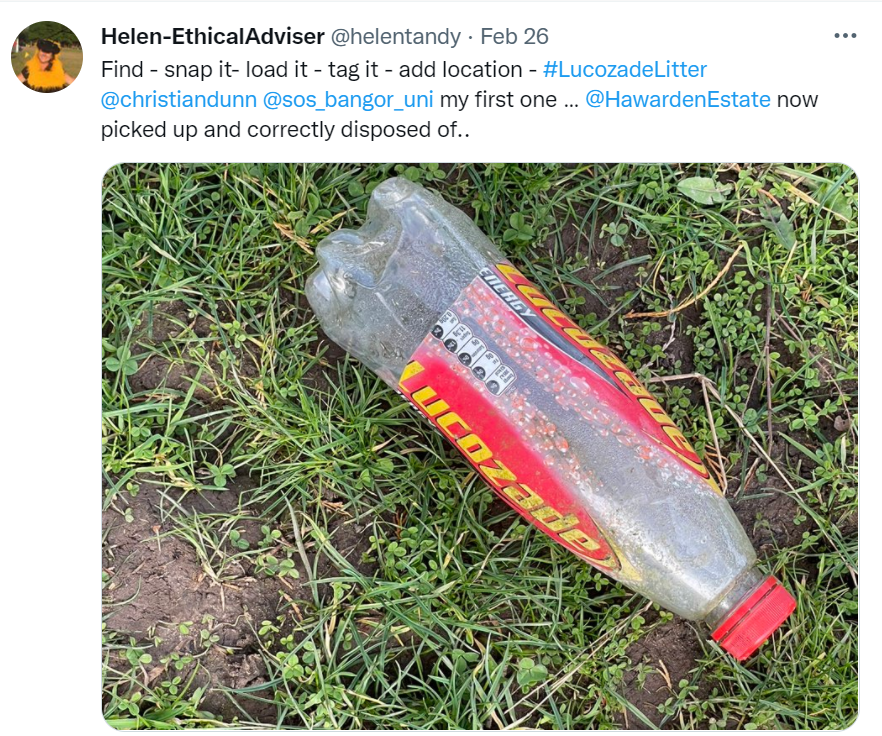
When Christian isn’t in his wellies in a Wetland he is campaigning about plastics, his role at Bangor University has allowed him to complete research on microplastics in our rivers and now the team are tracking litter. If you spot a discarded Lucozade drinks bottle, let them know using the hashtag #LucozadeLitter. (Bangor University)

So one final Tellus Reflection – We are ready to get the Community Litter Pick Hubs out, if you are part of a community that wants to rid where you live of litter and need some support and equipment let us know. We already have a few Hubs agreed but we have room for a few more.

Then what are you doing where you work, at home? Come and talk to us on our Mighty Network Channel and lets share all those great ideas in our community. Have you caught up on our Plastic Free Cheshire page?

Join our Mighty Network

Plogging comes to Chester this spring

A monthly litter-pick with a difference is set to be launched this Saturday at the Grosvenor Park in Chester to help spring clean the city.

The Plogability campaign aims to do its bit to keep Chester clean by organising family-friendly walking and jogging litter-picks on the first Saturday of every month through Spring.

Two routes will be led by volunteers – one walking and one running – taking around 45 minutes, with everyone picking up the rubbish they see along the way.

The event is being organised Helen Tandy, Simon Eardley and Christian and Carlotta Dunn from the Chester-based group EcoCommunities, and is supporting the work of other organisations like Welsh Dee Trust, Surfers Against Sewage and Keep Britain Tidy.

Helen Tandy said: “Plogging is doing a litter-pick whilst jogging, so it’s a great way to meet new people, do your bit for the environment and keep fit too.”

“We’re also going to be adding a walking route though, so that absolutely everyone can get involved in Chester’s Plogability,” Helen added.

All equipment will be provided for participants and the event starts at 3pm from the Pavilion in the Grosvenor Park in Chester on March 5 and go on for an hour.

Christian Dunn said: “Everyone is welcome to come along from families with small children to fitness addicts, we’ll be leading a gentle 5km jog and a walking route, but if you want to run more or at a faster pace, then go for it.

“Really, the only rule is you should try and keep moving whilst picking up the litter – which can take a bit of practise!”

Simon Eardley said: “It is planned that the Plogability event will be held every month through spring and participants will get the opportunity to weigh the amount of rubbish they collect so they can keep track of the good work their doing over the campaign.”

If you would like to help volunteer with organising Plogability then please contact office@sustainablecheshire.uk.

You can register for the first Plogability on Saturday by following the link, or just turn-up on the day: https://www.eventbrite.co.uk/e/plogability-chester-tickets-265781017177

What’s my Carbon Footprint?

A personal carbon footprint measures the greenhouse gases which are emitted as a result of the activities of an individual. Typically it’s measured in kilograms or tonnes of carbon dioxide ‘equivalents’. This is because whilst carbon dioxide is the main greenhouses gas it also needs to include other gases such as methane and nitrous oxide which have much greater global warming potential. The activities that a carbon footprint covers are broad, because so many of our day to day activities lead to greenhouse gas emissions.

They can be split out into 5 main areas

  • Running a home which includes heating, electricity and waste.
  • Transport because when we drive, fly or use other transport fossil fuels are often burnt.
  • What we eat, drink and any food we waste.
  • What we buy from clothes to electrical items to personal care.
  • The services we use which includes how we invest, where we stay on holiday and our mobile and internet

Adding these all up the average global carbon footprint for an individual is around 5 tonnes but it’s 9 tonnes in the UK, over 15 tonnes in the United States and under 2 tonnes in India. Whilst the majority of a carbon footprint is carbon dioxide the food we eat often adds methane (from livestock) and nitrous oxide (from fertilizer) to the total.

What’s my carbon footprint?

Everyone’s carbon footprint is different. Sometimes a little bit but often a lot with the richest 10% having an average carbon footprint over 20 tonnes whilst the poorest 50% are under 1 tonne. The one thing we do know is that people with higher footprints needs to dramatically cut them over the next 10 years with an aim to hit 2.5 tonnes, or less, by 2030. Ideally people would reach Net Zero (where any emissions we do create are balanced by removing carbon dioxide from the atmosphere) at the same time or as soon as possible after that.

The carbon footprint for an average UK person is shown in the chart. Normally our homes, what we eat and how we get around are the largest contributors making up roughly a quarter each. However, before we decide how to reduce our carbon footprints it’s important to get a more personalised estimate to make sure we’re looking in the right places for the big cuts. This is where personal carbon footprint calculators come in.

Eco Communities has joined Giki and we have an account for residents in Cheshire to work out their carbon footprint.

Eco Communities can help you understand, track and reduce your carbon footprint. You can also view how much as a community we have been able to reduce our impact on the planet collectively!

Make a Carbon Footprint Friends Pledge

If you are not joined up on Giki as yet, what can I do? Join us, calculate your Carbon Footprint and then choose 5 challenges to get you started.

Sustainable Travel – How flying impacts on climate change

Around 2.4% of global CO2 emissions come from aviation. Together with other gases and the water vapour trails produced by aircraft, the industry is responsible for around 5% of global warming. *BBC https://www.bbc.com/future/article/20200218-climate-change-how-to-cut-your-carbon-emissions-when-flying  

Even though Brits fly more on average than any other country, more than half of us took no flights at all last year. 22% took one return flight, and 11% took two. The campaign network Possible tells is.   

According to the Fellow Travellers, 15% of the population take 70% of all flights. People in that 15% group earn more than £115,000 a year. They tend to have a second home abroad. And their most popular destinations? Tax havens. How do we reduce the impact of flying without pricing ordinary people out of the skies? Fellow Travellers’ solution is pretty simple: scrap the current flight tax (Air Passenger Duty) and replace it with a Frequent Flyer Levy that taxes people based on how much they fly.  

Sustainable Money  -How can my money reduce Climate Change? 

Are your savings for the future being used to make that future worse? Choose a bank that invests in the type of things you agree with. Your money will help slow climate change, create jobs and drive green industries. Ask yourself in which companies your pension or investments are held.  

Many people still have the bank account they opened when they went to university and started work. If you want to ensure bank isn’t supporting the fossil fuel industry, check the list the top 5 ethical current accounts as 

  • Triodos Bank 
  • Nationwide Building Society 
  • The Cumberland
  • Engage 
  • Starling Bank 

Watch our session with Rebecca O’Connor (Becky) from Good With Money joined us to talk about money in June. Want to know how to be good with money?


But what about Pensions

There’s £2.6 trillion in UK pensions. This money is owned by all of us, and is invested to build our savings for the future. But from fossil fuels to tobacco, exploitation to extraction, these investments are often contradicting our values. That’s why we’re calling for our money to be invested in building a future we can be proud of, economies we can rely on, and an environment we can thrive in.

Join our Carbon Footprint Friends Project via Giki and rethink your home energy bills

Save energy, save money, save carbon  
Home energy bills are going up fast. So, here are some steps to help cut your heating bills immediately to save energy, save money and save carbon too.
As heating uses energy and creates carbon emissions, saving energy is a great way to save money and carbon too. So why not start with only heating rooms when you use them, and turning off radiators in unused rooms. 👇👇  
Turn off radiators in unused rooms
You can see below just how much of our home carbon footprint comes from fossil fuels. The biggest two parts in this example are gas and electricity (which is often made by burning fossil fuels). Most of our home footprint comes from heating and water heating. So these are really good places to save energy, save money and save carbon.
This chart shows how the average personal carbon footprint shapes up in the UK.  

Turn your thermostat down!
The majority of households in the UK and US could turn their thermostats down by 1C and still be at 18C or above. Turning down by just 1 degree is a great way to save energy. It is also a surprisingly big impact step, when you count up all the energy (and money, and carbon) you save over the winter. 👇👇  

Save energy on water heating too

There are also lots of ways to save energy when it comes to water heating. Why not try taking a shorter shower (and there are some more handy tips for saving hot water in this step too) 👇👇

The above is from Giki who are also helping people live more sustainably and are a great fit to what we are doing at Eco Communities and Sustainable Cheshire.
Eco Communities can help you understand, track and reduce your carbon footprint. You can also view how much as a community we have been able to reduce our impact on the planet collectively!

HyNet public debate – Thursday 3rd Feb

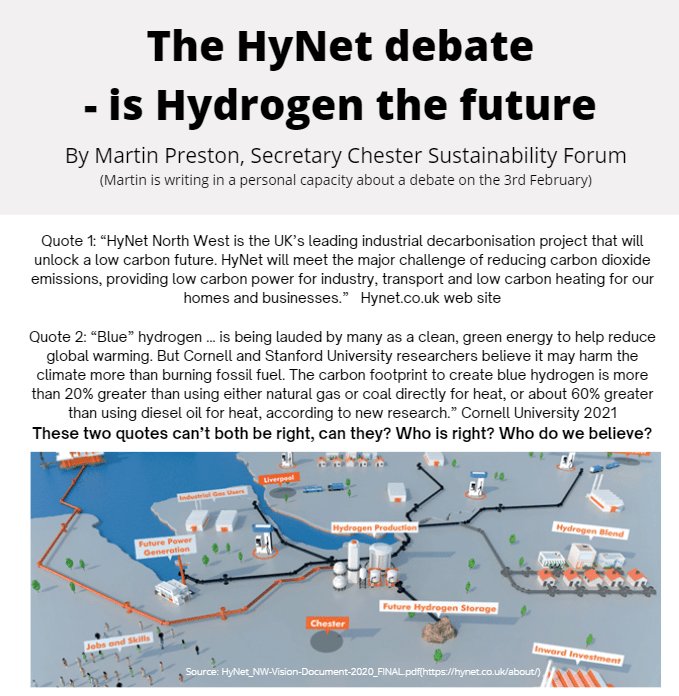
These two quotes can’t both be right, can they?  Who is right?  Who do we believe?

Not surprisingly, HyNet, a major North West industrial project to produce blue hydrogen, has polarised opinion amongst environmental campaigners and those working to decarbonise our cities and businesses.  In an attempt to increase understanding and bridge differences between the pro- and anti- HyNet camps, the Chester Sustainability Forum and Chris Matheson MP brought together experts from industry and academia, together with local politicians, to debate HyNet and blue hydrogen, and the opportunities and challenges for West Cheshire in becoming the centre of a new hydrogen-based economy.

The Storyhouse Garett Theatre was packed, the scene was set, as the first speaker, Professor Joe Howe of Chester University, gave an introduction to the Mersey “local industrial cluster”. The University is the ‘academic lead’ on North West decarbonisation, Joe is chair of the North West Hydrogen Alliance, and so he made an impassioned speech on the benefits HyNet would deliver to our region.

The case for the opposition was then set out by the second speaker, Green Party Councillor Paul Bowers.  Paul highlighted the massive level of subsidies the fossil fuel industry receives, over $5 trillion annually.  The blue hydrogen HyNet will produce requires 20% more gas to produce the same amount of usable energy, and the four plants currently operating only capture at best 41% of the carbon they emit.  The price for blue hydrogen is intrinsically linked to world gas market prices.  His conclusion: HyNet = (heavily subsidised) business as usual for the fossil fuel industry.

The third speaker was Dr Diarmaid Clery, from Manchester University’s Tyndall Centre, who explained the terminology and processes of industrial carbon capture and storage (CCS).  As currently applied to the exhaust emissions from a power station, CCS can remove 90% of the CO₂ at the cost of a 20% reduction in power output – so more fuel will be consumed to meet a given final power output. He also introduced the ‘carbon budget’ concept – the limit on carbon emissions needed to achieve the Paris Climate Treaty target of limiting the average global temperature rise to 1.5°C by 2050.  By now, to be on track, carbon emissions should be falling, but they are still rising.

For me, the most compelling speaker of the evening was David Cebon, Professor of Mechanical Engineering at Cambridge University and Director of the Centre for Sustainable Road Freight.  He focused on hydrogen for home heating, and presented relevant figures to consider when thinking about hydrogen as a fuel or heat source.  Starting with 100 kWh of electricity from renewable sources, he contrasted the difference in energy output from hydrogen boilers, simple electric space heaters and heat pumps, showing that heat pumps generate six times as much heat per kWh than hydrogen boilers.  And that’s for green hydrogen!

Source: Professor David Cebon

Converting UK domestic heating from natural gas to “blue hydrogen” would increase total gas consumption by 27%, leading to a 50% increase in gas imports.  So whilst Professor Cebon was clear that there is no case for hydrogen in home heating, he pointed out that hydrogen may make sense as a fuel in some specific processes, such as glass making, fertiliser production and steel production.

John Egan was next up.  John is North West Regional Lead at Progressive Energy, the company that is project managing the HyNet development.  He said that the climate emergency demanded urgent action.  At present, our local industrial cluster contributes about one fifth of the total carbon emissions from the entire North West total of industrial, domestic, travel, agriculture, etc.  He sees HyNet / ‘Blue hydrogen’ as one of a number of solutions to reducing total emissions, none of which are perfect – many technologies will play their part.  He mentioned that renewables currently supply only around 2% of the UK’s total energy needs, and, in global terms, the UK is doing relatively well in developing renewables.

As we neared the end of the evening, Don Naylor, one of the coordinators for Liverpool Friends of the Earth, took to the stage.  He drew attention to the appalling records of many fossil fuel companies operating in the global south, particularly in Mozambique: indigenous land grabs, wholesale human rights abuses, environmental destruction, corruption, etc. Don advocated that corporate social and environmental due diligence should be carried out on companies and partners involved in HyNet.

Finally, Chris Matheson, MP for Chester, drew out a number of salient points from the various presentations.  Critically, 5% of the UK’s total energy usage is concentrated on a 13-mile stretch of the Manchester Ship Canal between Eastham Locks in Ellesmere Port and Weston Point in Runcorn.  Chris perceives an urgent need to act, otherwise these industries will ultimately have to be closed down to meet the legally-binding 2050 ‘net zero’ target. He is willing to see if HyNet works, and hopes it will create new opportunities for our region.

Did this debate change anyone’s opinion of HyNet and blue hydrogen?  Somehow, I doubt it, though I hope that there’s now more understanding and respect for each side’s position.

HyNet means “business as usual” for our continued reliance on fossil fuels.  If the CCS aspect works at the 97% efficiency John Egan predicts (without presenting any supporting evidence), then I admit it will significantly reduce carbon emissions at the price of increased fuel use, meaning that we continue to invest in a fossil fuel industry that we really need to be closing down.

Many, myself included, would argue that more carbon emissions could be saved by investment in insulating buildings and installing heat pumps, proven technologies. This would create many more jobs, but is politically very much harder to do, as it involves persuading millions of individuals to incur expense and accept disruption at home and at work.  If, as a country, we are to meet our ‘net zero by 2050’ target, then we will inevitably need these measures to be taken further down the line, a legacy for future leaders and generations to tackle.

If you want to watch the HyNet Storyhouse debate, it is available for viewing on YouTube:

Part 1 (1 hr 54 mins) – https://youtu.be/_7ehNxuiGck

Part 2 (13 mins) – https://youtu.be/eGnMWJBxTPw