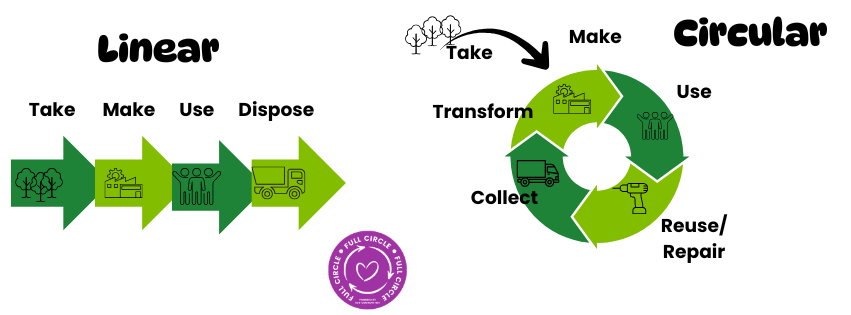
The circular economy is a different way of thinking about how we use resources. Instead of the traditional “take, make, dispose” approach, it focuses on keeping materials in use for as long as possible.
This means designing out waste, reusing and repairing what we already have, sharing resources, choosing refill options, and recycling as a last step, not the first.
It’s about seeing waste as a resource, not a problem.
By shifting to a circular approach, we can reduce carbon emissions, protect natural resources, and create stronger, more resilient local economies.
According to WRAP, 45% of global emissions can only be tackled by changing the way we make and consume products and food.
Why it matters
A large proportion of global emissions comes from the way we produce and consume everyday goods, from food and clothing to packaging and materials.
By changing how we make, use, and dispose of these items, we can significantly reduce our environmental impact.
The circular economy is not just about the environment — it also supports local businesses, creates jobs, and keeps value within our communities.
What does it look like in practice?
For individuals
- Repairing items instead of replacing them
- Using refill stations and avoiding single-use products
- Buying second-hand or choosing durable, long-lasting goods
- Sharing, borrowing, or renting instead of owning everything
- Recycling correctly and reducing waste where possible
Small everyday actions, multiplied across communities, create real change.
For organisations and businesses
- Designing products and services to last longer
- Reducing waste in operations and supply chains
- Offering repair, reuse, or take-back schemes
- Switching to refill or reusable packaging models
- Collaborating locally to share resources and reduce costs
A circular approach can reduce costs, build customer trust, and open up new opportunities for innovation and growth.
How to get involved
Everyone has a role to play in building a circular Cheshire.
You can get involved by:
- Supporting local businesses that offer repair, refill, and reuse options
- Joining or setting up community sharing initiatives
- Reviewing how you or your organisation use resources
- Taking small steps to reduce waste in everyday life
- Connecting with Eco Communities to learn more and take action
Together, we can create a culture where resources are valued, waste is reduced, and communities thrive.
Our role
At Eco Communities, we work with individuals, communities, and organisations across Cheshire to make the circular economy practical and achievable.
We provide support, share knowledge, and bring people together to drive real change — helping to build a more sustainable, connected, and resilient region.
WRAP Information
FOOD
Global food systems contribute 30% of global emissions, with a third of food produced being lost or wasted.
Circular food systems feed more people with less land. They promote healthy, diverse, and plant-based diets, and eliminate food loss and waste by re-distributing surplus food. Soil health is also protected by switching to nature-positive agricultural practices, and food by-products are used to create bio-based fertilisers and other useful products.
FASHION AND TEXTILES
8% of global greenhouse gas emissions come from clothing and footwear.
A circular economy for fashion and textiles aims to cut carbon and environmental impacts by designing out manufacturing waste, increasing the use of recycled and recyclable materials, and extending the life of garments. It also creates new types of fashion businesses such as hire, lease, and repair services. Fashion, apparel, and homewares businesses around the world are already piloting new circular approaches and seeing the benefits of circularity.
PLASTICS
3% of emissions come from plastic packaging – more than the 2.5% contribution from global aviation.
In a circular economy, problematic plastics are eliminated, and products and packaging are designed and made with recycled materials. They are also easily collected, sorted, and recycled into new items. New business models and innovation reduce the amount of packaging on supermarket shelves.
Cheshire West & Chester Climate Emergency
Read the regions:
Climate Emergency future for west Cheshire
Response Plan 2025-2030 CLICK HERE
 Sustainable Cheshire by Eco Communities